Many parents know the moment it happens: your child learns letter sounds, reads simple books, and then progress stops. Weeks pass with little change and reading time gets frustrating for everyone.
The good news: this early reader plateau is very common. In 30 years as a reading specialist, I’ve found simple shifts in reading practice make a big impact.
The strategies below are simple, practical ways to help early readers build the confidence, fluency, and stamina they need to move forward.
The Kitchen Table Trap: Why Your Dining Room is a “Stress Zone”
If reading time at your house ends with someone near tears (sometimes the child, sometimes the parent), you’re not alone.
It usually starts with good intentions. After dinner, everyone gathers at the kitchen table, the book comes out, and your child begins to read. A tricky word appears. A correction follows. The child sighs. A parent says, “Sound it out.” The sigh gets louder.
Before long, reading feels somewhat less like a story and more like a test.
Here’s the hidden problem: the kitchen table is already a stress zone.
For most kids, that table is where homework, like math corrections and spelling drills happens. When a book appears there, children often slip into performance mode, which hinders reading fluency.
Children stuck at the early reader stage don’t just need to decode words. They need to build fluency, which means reading smoothly, confidently, and with some rhythm. Fluency grows through repeated reading in a relaxed environment, not under the feeling of being tested.
When kids feel constantly watched or corrected, their brains focus on avoiding mistakes rather than building flow.
A small change can make a big difference. Move reading somewhere cozy-on the couch, in a blanket pile, or next to you on the bed. When the environment relaxes, kids often read more freely, and their stamina grows right along with their confidence.
Try This Tonight
– Move reading to a snug spot instead of the kitchen table.
– Sit next to your child, not across from them.
– Let them reread a familiar book. Repetition builds fluency faster than constantly starting new books.
A relaxed reader is much more likely to become a confident one.
The 90% Rule: The Secret to Building Speed Without the Tears
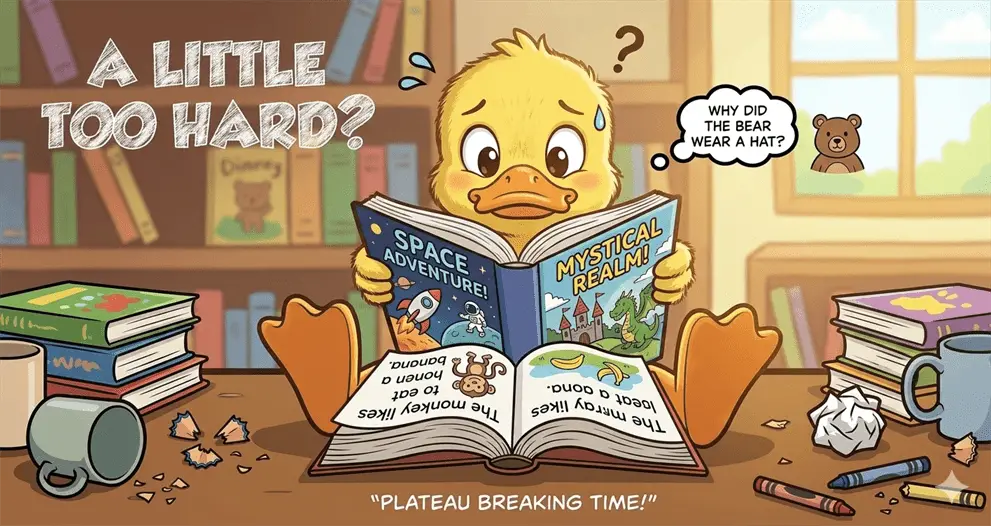
One of the biggest reasons children get stuck at the early reader stage is surprisingly simple: the books are too hard.
It’s a very common pattern. A child finishes a few beginner books, so naturally, the next step seems to be moving up to something more challenging. The problem is that when too many words are unfamiliar, reading stops feeling like reading and becomes more like decoding practice.
That’s where the 90% Rule comes in.
For fluency, children should recognize about 90% of the words without help. This lets most sentences read smoothly and keeps focus on reading, not just decoding.
Think about riding a bike. If the path is mostly smooth with a few bumps, kids keep pedaling. If the path is full of rocks, they stop every few feet. Reading works the same way.
Repeated reading helps children build speed, expression, and confidence. What formerly seemed like work soon becomes automatic. With adequate repetition, patterns learned can be easily transferred to new books.
And confident readers are far more willing to handle new words when they appear.
Try This Tonight
– Choose a book where your child can read most of the words easily.
– If they stumble on more than 1-2 words per page, the book may be too difficult right now.
– Encourage your child to reread a favorite book from earlier in the week. Each reread strengthens fluency and stamina.
The Visual Bridge: Using Pictures to Unlock Challenging Vocabulary
Early readers commonly rely on pictures more than adults realize-and that’s actually a good thing.
Pictures are a visual bridge between spoken and printed words. When a child pauses on an unfamiliar word, the illustration often gives a clue, helping them connect meaning and print.
Sometimes parents worry that their child is “guessing from the pictures.” But in early reading, pictures are meant to support comprehension while decoding skills are still developing.
Think of illustrations as helpful training wheels.
For example, if a sentence reads, “The raccoon climbed the fence,” and the picture clearly shows a raccoon on a fence, your child can use that visual information to unlock a word they may not yet fully recognize. Once they hear the word and connect it to the print, their brain stores that lexicon for next time.
Over time, those supported moments add up. The word that required help today becomes a word they recognize instantly next week.
Pictures also help children stay connected to the story’s meaning, which keeps reading enjoyable. And enjoyment matters more than many people realize. When kids care about what they’re reading, they’re much more willing to keep going even when a tricky word appears.
Try This Tonight
– Before reading a page, take a quick “picture walk.” Ask your child what they think might happen.
– When your child gets stuck on a word, gently ask, “What’s happening in the picture?”
– After solving the word, have your child reread the sentence smoothly to build fluency.
Rigging the Game: How to Manufacture Small Wins Every Day
When a child feels stuck in early reading, the most important ingredient isn’t a harder book or a longer practice session.
It’s a success.
Children build reading stamina and confidence through frequent, small successes. These occasions reinforce the belief: “I can do this.”
But if every single reading session seems difficult, that belief never gets a chance to grow.
This is why I often encourage parents to quietly “rig the game” in their child’s favor. That simply means setting up reading situations where success is very likely.
Choose books slightly below your child’s maximum level. Let them reread stories they already know well. When children read familiar text, something wonderful happens: their speed increases, their voice becomes more expressive, and their reading sounds natural rather than effortful.
Those moments matter. Each successful reading experience builds more confidence and stamina, making readers more willing to meet challenges.
It’s like basketball; practice builds muscle memory. Enough successful shots help players remember success.
Reading works the same way.
Try This Tonight
– Start with a book your child has already read before. Familiar text builds fluency quickly.
– Let your child read one short book all the way through without interruption.
– Celebrate the effort: “You read that smoothly!” or “Your reading sounded really strong.”
Plateau or Problem? Knowing When to Call in a Professional
Most early reader plateaus are normal. Reading develops in bursts and quiet periods as children practice and strengthen skills.
But sometimes parents wonder if a plateau might be something more.
Look for constant effort and progress. If regular practice, 90% rule books, and rereading don’t lead to improvement after months, consider asking some questions.
For example:
Does your child struggle to remember letter sounds they’ve already learned?
Do simple words seem unfamiliar every time they appear?
Does reading remain extremely slow or exhausting even with easier books?
Does the child reverse letters or sounds?
When these patterns exist, an experienced teacher or reading specialist can take a closer look. Sometimes the issue is simply that a child needs more targeted phonics support or a slightly different instructional approach. In other cases, there may be an underlying reading difficulty that benefits from early support.
The important thing for parents to remember is this: seeking help is not a failure-it’s a shortcut. The earlier a reading challenge is identified, the easier it is to address.
Reading should gradually feel smoother, more confident, and less tiring for children. If that shift isn’t happening despite steady practice, a professional can help identify exactly what’s getting in the way.
Breaking Through the Plateau
Reading progress is rarely linear. Many “stuck” early readers just need the right mix of practice, confidence, and manageable challenges. Small shifts, easier books, rereading, relaxed spaces, and celebrating wins, can make a big difference over time.
When children experience success, their confidence and stamina grow, and reading feels less like work and more like discovery. And that’s often the moment when the plateau finally begins to break.
About the Author
Becky Rodgers, M.Ed., is a retired K-8 reading specialist with more than 30 years of experience helping children become confident readers. She is the co-founder of ReadingDuck.com, a website where she started to share the practical reading lessons, activities, and strategies she used successfully in her own classroom. What began as a small effort to help families in her community has grown into a widely used literacy resource supported by a team of educators who believe in the Science of Reading.